
Key Takeaways
- Understanding how CCTV works helps operators respond faster and make better decisions during incidents
- A complete surveillance system workflow involves capture, transmission, storage, and monitoring
- Modern systems rely on video management system (VMS) platforms to organise and control footage
- Technical knowledge supports tasks like basic troubleshooting and efficient playback review
- In Singapore, operators are increasingly expected to go beyond monitoring and develop system-level awareness, supported by training such as a CCTV course in Singapore with WSQ.
Introduction
To most people, a CCTV system seems straightforward. A camera records footage, and an operator watches it on a screen. In reality, what happens behind the scenes is far more complex.
From the moment an image is captured to the point it is stored or reviewed, multiple processes and components are involved. For operators, understanding this process is not just a matter of technical knowledge. It directly affects how effectively they can monitor situations, respond to incidents, and manage surveillance systems.
This article breaks down how CCTV works behind the scenes and why that knowledge matters in real-world operations.
How CCTV Operations Work in Singapore
In Singapore, CCTV operations fall within a structured security industry with defined expectations.
Operators may require:
- Security licensing under regulatory frameworks
- Familiarity with surveillance systems used in commercial and public environments
- Awareness of data handling and privacy considerations
As surveillance expands across sectors such as residential care, infrastructure, and commercial facilities, there is increasing emphasis on trained operators who understand both operations and system processes.
Understanding the Full Surveillance System Workflow
More Than Just Cameras and Screens
A CCTV system operates as a continuous workflow rather than a single function. Each stage connects to the next, forming a structured surveillance system workflow that determines how usable and reliable the footage will be.
This workflow typically includes:
- Image capture
- Signal transmission
- Recording and storage
- Monitoring and control
- Playback and review
When one stage fails or underperforms, the entire system is affected. This is why operators benefit from understanding how each part contributes to the whole.
What Happens Behind the Scenes
Step 1: Image Capture; Where It All Begins
Every CCTV system starts with image capture.
Cameras convert visual information into digital signals. Depending on the setup, this may involve analogue cameras transmitting signals through cables or IP cameras processing data for network transmission.
Several factors directly affect footage quality:
- Resolution
- Lighting conditions
- Camera positioning and lens angle
For operators, poor image capture limits the ability to identify individuals or interpret events accurately. Understanding this stage helps them recognise whether an issue is environmental or technical.
Step 2: Signal Transmission; Moving the Data
Once footage is captured, it must be transmitted to a central system.
This happens through:
- Coaxial cables in analogue systems
- Network infrastructure in IP-based systems
At this stage, issues such as latency, signal loss, or network congestion may occur. Operators often experience these as lag, delays, or interruptions in live feeds.
Recognising that these are transmission-related issues allows operators to escalate problems accurately rather than assuming a camera failure. This is a key skill for understanding the principles of CCTV effectively in real-world environments.
Step 3: Recording and Storage – Where Footage Is Kept
Captured footage is stored using:
- Digital Video Recorders (DVR)
- Network Video Recorders (NVR)
These systems compress and store video data for future retrieval. Storage configurations determine:
- Retention duration
- Recording quality
- Accessibility of footage
Operators need to understand how storage works to avoid missing critical footage. Without this knowledge, important recordings may be overwritten or difficult to retrieve during investigations.
Step 4: Monitoring; The Operator’s Role
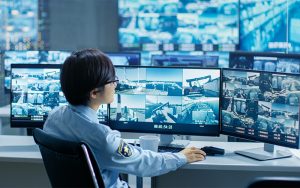
Monitoring is where operators engage directly with the system.
However, effective monitoring involves more than watching screens. Operators must:
- Identify unusual activity
- Switch between camera feeds
- Respond to alerts quickly
- Communicate findings clearly
Modern systems often integrate alarms, access control, and analytics, reflecting growing system integration in security surveillance.
This integration increases complexity. Operators who understand system behaviour can respond more confidently and avoid being overwhelmed by multiple inputs.
Step 5: Playback and Incident Review
When incidents occur, recorded footage becomes critical.
Operators must:
- Locate the correct time and camera
- Review footage accurately
- Extract relevant clips
This process depends on familiarity with system navigation and recording configurations. Many systems today use a video management system (VMS) to organise footage, making it easier to search, tag, and retrieve data efficiently.
A lack of understanding at this stage can delay investigations or lead to incomplete reporting.
To move from understanding the process to applying it in real-world scenarios, it is equally important to look at the tools that make the system work and the common issues that can affect its performance.
Key Components Working Together
A CCTV system includes several interconnected components:
- Cameras
- Cabling or network infrastructure
- Recording devices (DVR/NVR)
- Storage systems
- Monitors and control interfaces
- Software platforms such as VMS
Each component contributes to how CCTV works as a complete system. When one element fails, the overall performance is affected, emphasising the need for a holistic understanding.
Operators who grasp these components can better support CCTV system configuration and troubleshooting, especially when identifying the root cause of issues.
Common Issues Operators Should Recognise
Even well-installed systems encounter problems. Operators must be able to recognise the symptoms of technical issues to report them correctly. Common issues include:
- Blurry footage from a poor camera setup
- Lag due to network limitations
- Recording gaps caused by storage issues
- Blind spots from incorrect placement
Operators who understand system behaviour can:
- Identify likely causes quickly
- Report issues accurately
- Support faster resolution
This reduces downtime and improves overall system reliability.
Why This Knowledge Matters for Operators
CCTV operators today are expected to do more than observe.
Employers increasingly look for individuals who can:
- Understand how systems function
- Troubleshoot basic issues
- Handle surveillance data responsibly
- Work with integrated systems
This shift reflects a growing demand for technical awareness. Knowing how CCTV works allows operators to move from passive monitoring to active system management.
Bridging the Skills Gap
Structured training helps bridge this gap by combining theory with practical application.
Learning beyond the basics builds confidence and prepares operators for evolving system demands.
In Singapore, this typically takes the form of Workforce Skills Qualifications (WSQ)-aligned courses and specialised training programmes focused on surveillance operations.
These courses often cover areas such as system workflows, incident response, footage review, and basic troubleshooting. Some programmes also introduce learners to integrated environments, where CCTV systems work alongside access control and alarm systems, reflecting how surveillance is used in real-world settings.
For those looking to deepen their technical understanding, more advanced training can help operators move beyond basic monitoring into more capable, system-aware roles. This shift is increasingly valuable as employers look for individuals who can not only observe incidents, but also understand system behaviour, identify issues early, and respond with greater confidence.
Ultimately, bridging the skills gap is not just about meeting job requirements. It is about developing the awareness and capability to work effectively in increasingly complex security environments.
Conclusion
For operators, understanding these processes is no longer optional. It supports better decision-making, faster response times, and stronger overall performance.
Beyond day-to-day tasks, building this level of understanding opens the door to career progression. As surveillance systems become more advanced and integrated, employers are placing greater value on operators who can take on broader responsibilities, support system management, and move into more specialised or supervisory roles. Developing these skills is a practical step towards staying relevant and advancing within the industry.
At Apollo Global Academy, our CCTV certification courses are designed to support this growth. By combining foundational knowledge with practical application, we help learners strengthen their capabilities and prepare for the next stage of their careers.
If you are looking to build confidence and progress in the security industry, reach out today to learn how our programmes can support your next step.